
Most brands are starving for Walmart content. Once you start counting the ways you need it, the shortage gets obvious fast. You need influencer video to build in-store awareness. You need ad creative for paid social, CTV, and wherever else you buy media. You need assets for Walmart Connect placements and your product detail pages. That is three distinct content needs, and video is already the bottleneck for every one of them.
The problem got bigger this year. Walmart Marketplace crossed roughly 200,000 active third-party sellers in 2025, up from 160,000 the year before, a 25% jump. Walmart's US online sales grew 26% in the quarter ending April 2026, and marketplace sales grew nearly 50%, per Digital Commerce 360. More brands are fighting for the same shelf, and they all need the same thing: a steady stream of good video that does not require three full-time hires or a bloated agency retainer.
Content is a volume game. If you land a handful of videos, you have missed the entire point, because a handful does not feed paid social, CTV, retail media, and your PDPs at the same time. You need enough to test, to refresh, and to run across every channel without recycling the same three assets until they burn out.
The volume pressure is not unique to Walmart. Eighty percent of marketers say they are producing more content than a year ago, but only a fraction saw budget or headcount grow to match it, according to reporting on the content volume crisis. Ninety-one percent of businesses now use video as a marketing tool, per Sprout Social, and 47% of marketers name creative adaptation across formats as a top challenge. A single campaign might need a 30-second CTV spot, a six-second pre-roll, a shoppable social unit, and a PDP clip. That is a lot of cuts from source footage you do not have enough of.
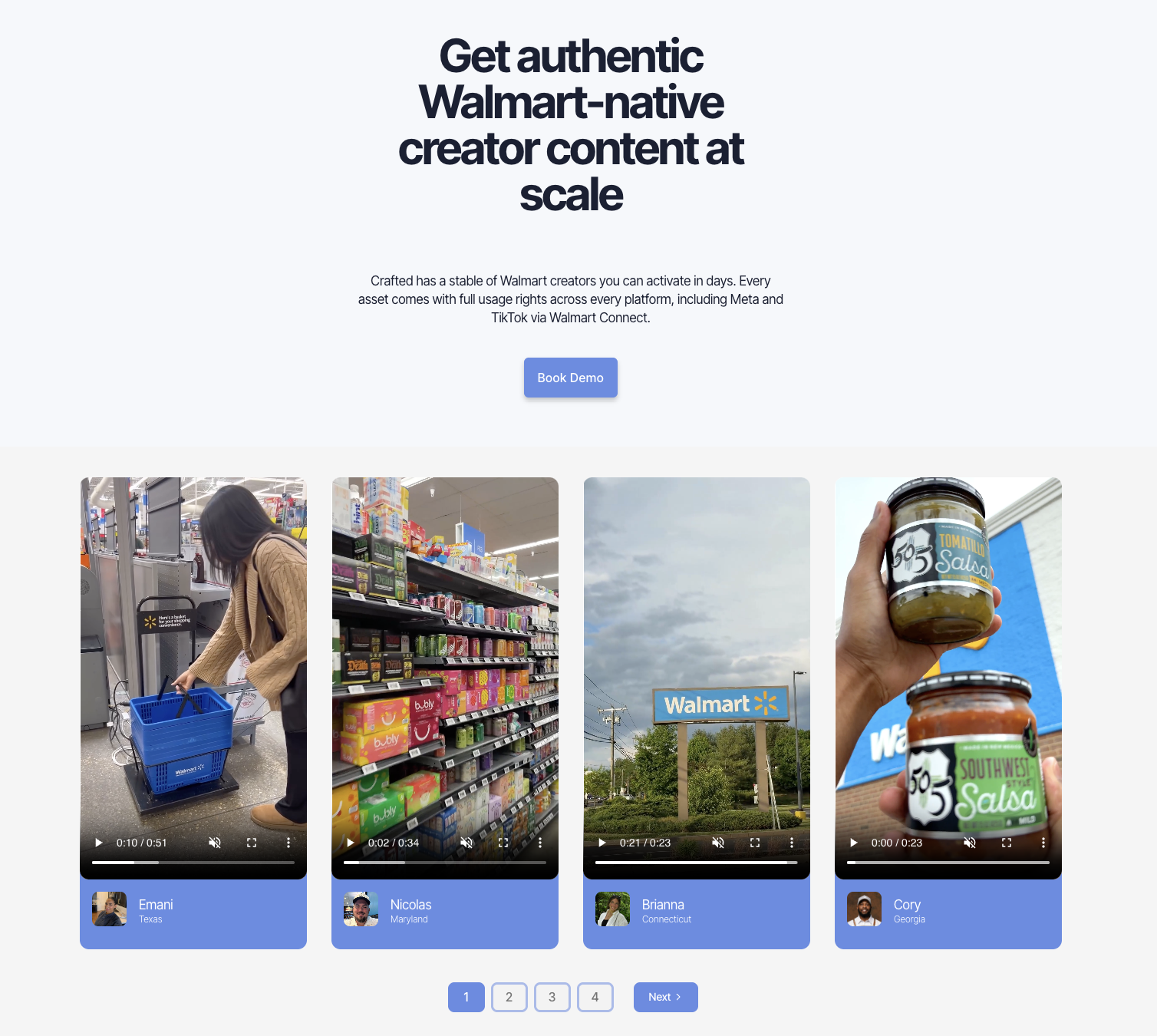
Walmart-specific content is even harder, because the creators who genuinely shop and film at Walmart are a narrow slice of the influencer world. Most platforms and agencies are ecommerce-first. They can find you a beauty creator with a Shopify code. Finding someone who walks into a Supercenter, films an honest review in the aisle, and makes it look native to the store is a different skill and a different roster.
Here is the workflow we run at Crafted, end to end. It is deliberately simple, because complexity is what kills volume.
Launch a brief. You define the product, the retailer, the format, and the message. If you want Walmart-specific reviews filmed in-store, you say so. The brief goes out to a curated network, not a public marketplace.
Creators apply. People who fit the brief raise their hand. You are not cold-hunting anyone. You see who wants to work on it and what they have made before.
You approve. You pick the creators you want. This is where curation matters, because you are choosing from people who already perform in a physical store, not scrolling an open directory hoping someone is a fit.
You review. The content comes back, and you review it before anything is final. If it is not right, it gets fixed.
You get the rights. This is the step most brands underweight. When you own the usage rights in perpetuity, one asset can run everywhere: paid social, CTV, Walmart Connect, your PDPs, no lawyer in the loop every time you want to reuse a clip. Retailers themselves largely lack a content-rights framework, which is exactly why owning it upfront is such an advantage.
Brands usually default to one of three options, and each has a real ceiling.
The first is Walmart Creator, Walmart's own program. It is a self-serve affiliate platform where creators earn commissions on links, with rates that vary by category and no follower minimum. It is useful for affiliate sales, but the creators are not curated for your brand and you are not commissioning content to a brief. You cannot build a reliable, on-brand video pipeline out of an open affiliate tool.
The second is generalist influencer platforms and agencies. There are plenty of them, and almost none specialize in Walmart creators or in retail at all. They are built for ecommerce, so you get creators optimized for a checkout link rather than a store visit. The roster is the whole game, and their roster is pointed at a different problem.
The third is sourcing creators yourself. You can absolutely hunt these people down. It is slow, manual, and painful, and because content is a volume game, a DIY process that lands you five creators a quarter has already lost. The math does not work when you need dozens of assets across formats.
Volume only works if the brief is tight enough that a stranger can nail it without a call. A good Walmart brief names the exact product and where to find it in-store, the retailer and whether you want the store shown, the format and aspect ratios you need, and the one or two things the video has to communicate. It gives the creator room to sound like themselves, because that is the whole reason UGC works. Product pages featuring user-generated content convert 161% higher than pages without it, and 92% of consumers trust peer recommendations over brand messaging, per Loop. Over-scripting a creator sands off the exact thing that makes their content perform.
A tight brief also lets you run many creators against the same ask at once, which is how you get variety without chaos. Ten creators working the same brief give you ten honest takes on the same product, filmed in ten different stores, and that spread is gold for testing what resonates before you put media behind it.
The reason to solve this now is that the distribution is finally catching up to the content. Walmart Connect made its first-party shopper data activatable inside Google's Display & Video 360, starting with YouTube, in June 2026. That means you can tie video views to real Walmart purchases, online and in-store. US retail media spend is on track for nearly $70 billion in 2026, per eMarketer, and Walmart Connect is one of the two networks absorbing almost all of the incremental growth, with roughly $9.4 billion of $10.5 billion in incremental spend going to Amazon Ads and Walmart Connect.
The payoff of owning your content is that a single asset stops being a single asset. One creator video, shot to a good brief with rights you own, becomes an in-store awareness post, a paid social ad, a CTV cut, a Walmart Connect placement, and a PDP clip. The math changes completely when your cost per asset gets divided across five channels instead of one. Crafted campaigns built this way have driven a 19.5% sales lift for a marinated chicken brand at Walmart and a 17% lift for a produce brand at Food Lion, because the content was made for the store and ran everywhere the shopper was.
The pipes are getting better every quarter. The pipes are useless if you have nothing quality to put through them. A curated, retail-native creator network is how you fill them, and it is why we spent five years building one full of people who shine in store: moms, foodies, lifestyle creators, and product reviewers who actually walk into Walmart. If you are short on Walmart content, the fix is a repeatable process, not another one-off shoot.
.svg)
.svg)
.svg)
.svg)

.svg)
.svg)
.svg)


